Showing posts with label preserving. Show all posts

Wednesday, 7 September 2016

Slow cooker gingerbread spiced apple butter


Apple butter is a largely American preserve - Pinterest is full of recipes at this time of year. For me it's an ideal way to use up apples from our tree, we love it. Put simply it's a cross between a very soft jam and a thick apple sauce. Oddly apple butter is completely dairy free - the butter is a nod to how you use this preserve; spread thickly on toast, heaped onto drop scones, fluffy, American style pancakes or waffles or even dolloped generously onto porridge.

I last made apple butter when I was pregnant with Harry - I spent a weekend making apple butter, chutney and anything else I could use up the harvest from our two apple trees, giving them away to everyone that helped with the mammoth move into our then new home. The last couple of years have found me up to my eyes in a newborn, and then a toddler so apples have been given away. But this year I'm feeling a little more like I've found a balance between my role as Mama and a blogger so it felt like the right time to revisit my love of preserving.  This recipe is ideal when trying to find a balance - once the apples are peeled, cored and chopped all you have to do is add them to the slow cooker and leave it on low for 12 hours. The smell of the cooking apples fills your house like an advert for autumn.

I prefer my apple butter to be on the tart side of things, and this kind of preserve is much more forgiving of an adjustment to the spicing or sweetness without impacting on the final product.


Dressed up sweetly, jars of apple butter make a lovely autumnal gift, or just a glorious addition to your fall breakfast table.


Slow cooker gingerbread spiced apple butter
Yield: 6 half pint jars

6lb cooking apples
1 cup date syrup
Juice of 1/2 a lemon
2 teaspoons ground cinnamon
2 teaspoons ground ginger
1 and a half teaspoons ground cloves
1 and a half teaspoons freshly ground nutmeg
1 pint of water

Peel, core and slice your apples - I borrowed this amazing gadget from a dear friend which made the whole process much quicker.
Put the apples into your slow cooker
Add the date syrup, lemon juice, spices and water
Put the lid on and leave on low for 12 hours, to start with stir every hour or so, to mix everything up. I did this every time I remembered so it's not something to set an alarm on your phone for.
Use a stick blender to puree the now thick, fragrant apple mixture
Take the lid off the slow cooker and leave on high for another hour to thicken up - you want the apple butter to be spreadable rather than pourable.

Sterilise some jars, I needed 6. I pop the jars into the oven on low for about 10 minutes, then add the hot apple butter before putting on the lids.
Then, if you're me, it's time for labelling and generally prettifying any you want to give away.

Apple butter doesn't keep like jams or jellies so you're looking at a month or so, kept in the fridge, once opened.

I'm adding this to  Farmersgirl Kitchen and BakingQueen74 monthly Slow Cooked Challenge.


I'm also adding this to A Mummy Too's Recipe of the week link up


Link up your recipe of the week

Tuesday, 16 October 2012

Preserving exploits: The October edition


Today, a bright, crisp and chilly Sunday saw me thus attired - naturally for sloe picking. M and I marched off in the sunshine, to our local spot for foraging, only to find a complete absence of sloes. When we had last been there for the blackberries there were definitely some sloes there, not a great deal, but a few. Today however, none. At all. Clearly lacking in tenacity I suggested giving up, but remembered where our Brown Owl gets her damsons from and wondered if there might be sloes there. So we hopped in the car and pottered over, fortunately finding plenty of fruit to forage. 


The Blackthorn bushes had already been well stripped with many of the sloes being out of our reach, so we developed new rules - if you couldn't reach the berries with your feet flat on the floor and your arm outstretched, they belonged to the blackbirds. Seeing as the 'harvest' was fairly sparse in our area I felt that was fairer, so no walking sticks, branches or any adaptations to make our work easier were used. We're both slightly scratched, but nothing a hot bath couldn't cure, and the sloes are ready to go into the freezer overnight. 


I was absolutely stunned to discover we had picked 1.5kg of sloes, as I thought we had far less. By my reckoning, that's plenty for 3 litres of gin. If I normally get you a Christmas present and it's you don't drink - tell me now! I'll pick up sugar and gin tomorrow and will strain the last lot of blackberry vodka tonight so that I can put my large kilners back in rotation. 


I should probably update you - as this weekend has been a bit of a bottling spree as it were - all the Blackberry vodka has been bottled, the Blackberry and blackcurrant rum has been sweetened and strained, and the Blackberry gin is just waiting for the new bottles to be sterilised so that that can go in. I'm like a one woman distillery! 


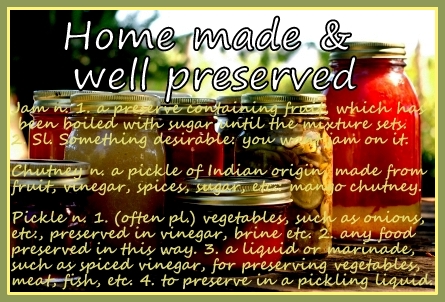
So, sloes are ready to go - and this round up of my preserving exploits for the last couple of months is also my entry to A Little bit of heaven on a plate's Home Made and Well Preserved linky


Also... Rhubarb and ginger jam (which I'm saving for Christmas presents but desperately want to eat myself!)


Saturday, 15 September 2012

Preserving prettiness: Rhubarb and ginger jam


Rhubarb and ginger is one of my favourite flavour combinations. I keep meaning to bake a cake based on it, but as yet have forgotten. Most often I stew rhubarb with a tiny bit of sugar and some ground ginger to top porridge or yoghurt.

The other weekend Tesco were selling off their rhubarb for under half price. I nabbed two of the 400g packets with the original plan to stew it. On noticing that I had a tub of stewed from M's mum already in the freezer I thought a new plan was in order. So it was time to break out the maslin pan, jam spoon and jars and get preserving.

This is based on a WI recipe

800g rhubarb cut into 1 inch pieces
800g granulated sugar
50g crystallised ginger (the one covered in brown sugar if you can get it) finely chopped
Juice of 1 lemon

Cut the rhubarb up and put in a large mixing bowl. Top with the sugar and cover with a tea towel. Leave overnight.

The next day stir in the sugar - most of it will have dissolved, if you feel like it's not started dissolving, leave longer (I left mine for 2 days without incident)
Pour into your pan, scraping down the sides of the bowl to get everything out


Chop your ginger really finely (this is my favourite of any photo I've taken. Ever)


Add the ginger and the lemon juice to the pan
Bring gently to the boil, stirring all the while. Skim off any scum that comes to the surface (or be lazy like me and just stir in a knob of butter at the end)


Boil for 30 minutes or until the sugar starts to flake on the edges of the pan


Do the saucer test to make sure that the jam has set
Use a funnel to pour the jam into sterilised jars, seal and when cool label


It's as simple as that. I may have taste tested the scrapings in the pan as this is destined to be Christmas presents. Yes, I said it again.

Wednesday, 22 August 2012

I feel pretty, oh so pretty... Preserving


Over the last couple of weeks when we've been going along in the car, I've not paid M a great deal of attention (sorry). My eyes have been trained on trees and hedgerows looking for a glimpse of the bounty late summer and early autumn brings the keen and nifty cook.

The blackberries are nearly there, those that have benefitted from the (occasional) sunshine already turning glossy and purple, those in more shady spots just hitting a glorious rose. I dragged M out this afternoon and between us we managed to pick 2lb or so of beautifully ripe blackberries - I have earmarked half of this for apple and blackberry jelly (one of M's mum's recipes) but the other half is destined for more alcohol. 

I haven't seen either elderberries or sloes yet but they are normally Autumn's later gifts.

As you know whilst my patience with dough and children is legendary, my patience for my need to preserve less so. It was with (a swiftly stifled) squeal of delight on Friday evening that I noticed that Sainsburys had marked down three punnets of blackcurrants and two of blackberries. I gazed around me, sizing up the other shoppers, trying to decide if there might be any competition, and then swooped in, scooping up the punnets into my trolley and heading off in search of the Basics rum. Apparently Sainsburys don't do Basics rum, so I got the next one up the ladder.


I followed the recipe I used a couple of years back where you start by making and straining a berry juice, and then add spices and alcohol, leaving it to mature briefly before boiling up with sugar and bottling. Previously I did this with redcurrants and you can see in the photos in the original post the pretty pink colour of the end result. Unsurprisingly doing this with blackberries and blackcurrants produces a stunningly dark and glossy liquer. The vodka and this rum are all destined to be gifts 

I wanted to write this post despite the recipes not being new ones, and the photos all being on Instagram already to remind you just how easy preserving is and how fabulous the results can be. You don't need a sugar thermometer, jam sugar, a maslin pan, or even a jam spoon - I start with my Ikea 365 pan, a long handled wooden spoon and a saucer in the freezer. That's it. I don't even buy jam jars, I save all ours, and ask Guide parents to donate any they have. Sterilised with boiling water and in a low oven, you're good to go. Also, my jellies (and alcohol is all strained through an old pillowcase in a seive. Yes, the picture below is an old pillowcase. 


If you're west of me, you may still be able to get some strawberries at your local PYO so why not have a go at strawberry jam (see the idiots guide on that post)

Otherwise, go, forage (or buy heavily reduced) blackberries and have a go at vodka, rum or jam. I'll put my recipe for blackberry and apple jelly up as soon as I've done it. 

For all my preserving exploits - click here and you'll be able to scroll through and pick the ones that appeal to you. 

Tuesday, 7 August 2012

Herb oils: two ways to infuse

I seem to be all about 'doing the double' this week, unlike our amazing athletes it's all about the food, no medals here. Sad times. Although I am entering this as part of Karen at Lavender and Loveage's Herbs on Saturday linkup


Now I have to confess (despite using the word twice in my last post) I don't really 'do' drizzle. To me it makes me feel like I'm trying too hard, like I'm pretending to be a restaurant chef when we all know I'm a home cook in slippers and a Cath Kidston pinny. Not just that obviously, I'm not some kind of slipper & pinny wearing pervert!

However, flavoured oils to me come under the heading of preserves. And we all know how excited the Pantry gets about the prospect of preserving. Too excited.

The first flavoured oils I made were chilli oils as a Christmas present for my dad. Simply add dried chillies to an unflavoured oil (groundnut works well) Decant into a sterilised bottle, seal and keep in a dark cupboard. The flavour will get stronger and stronger the longer it's kept as the chillies continue to infuse, so that's best kept for lovers of that chilli kick.

However today is all about the herbs. In my bundle of goodies from Asda was a bag of watercress. And as luck would have it I had some parsley and basil in a jug on my worktop.

Pantry tip: store cut herbs as you would cut flowers (but maybe in a jug not your best crystal vase) topping up the water regularly and they'll stay fresh far longer.

I should just note that salad leaves like rocket grow like weeds in the tiniest window box or pot, and even when carelessly neglected will grow beautifully. You can reseed your pot intermittently so that over the course of the summer you have a cheap, quick and instant source of salad.

Pantry tip 2: yesterday I mentioned when to spend your money on mozzarella and when to save it. Olive oil is similar, to cook with use a plain and simple olive oil (or even an unflavoured oil like groundnut) but if you're using it raw as it were go all out with the extra virgin. Don't go mad but you want one that tastes fresh and vibrant as it is. Although you're infusing herbs into it, the flavour of the oil will continue to shine through.

Watercress & herb oil - the quick and easy one


Fill a 1 pint jug with your herbs. I used watercress, parsley and basil. Blitz these in a food processor, until really finely chopped.

Measure half a pint of good quality olive oil and pour that into your food processor with the motor running slowly.

Taste, season if necessary and use over salads, grilled meats or you could add toasted pine nuts and finely grated Parmesan for a quick and easy take on pesto. You probably won't want salt if you're taking this on to pesto as the salt from the cheese will be enough.

If you decant this into a sterilised jar and ensure that you cover it with a layer of extra olive oil it will keep in the fridge for a week or so.

What's nice about this is how the really peppery kick of the watercress comes through, contrasting with the softer flavours of the basil and parsley.

Watercress and herb oil: take two - cold infusion


Now for the preserving. This means that the oil will keep for much longer, and the flavour is intensified. It is strained through muslin as you would for a jelly so the pieces of herbs are discarded.

You start the same way with a pint of herbs, which you bring to yhe boil in a pan of water, straining almost immediately it comes to the boil and refresing under cold water.

Then blitz this, adding half a pint of good olive oil.

Strain this mixture through a seive letting the oil drip through slowly into a bowl. Resist the urge to push the oils through as that will make your end result cloudy.

You can bottle at this stage, using sterilised bottles, or you can strain again, lining your seive with muslin (or a clean, old pillowcase) and then bottle.

This will keep in the fridge a little longer than the easier option and is a wonderful addition to salads (especially yesterday's mozzarella and tomato salad) It also makes a lovely present as the verdant green oil is so beautiful and a fantastic alternative home-made gift for someone who perhaps doesn't like marmalade, jam, sloe gin, or elderberry cordial.


Wednesday, 27 June 2012

Moonlight and Vodka. Blackberry vodka to be precise


It feels like ages since I've done any preserving - I think marmalade was my last foray into one of my favourite pastimes. Seriously preserving is up there with Musicals, good books and baking. What can I say? It's just who I am.

So, we're wandering around Sainsburys and there are three, lonely punnets of blackberries. Wildly off season, imported from Turkey, but less than a pound for all three. Faced with such a bargain, I broke my "not if it's not in season" rule and decided to indulge. And that's when blackberry vodka was born, between picking up the blackberries in aisle one, and finding the value vodka in aisle 27 my decision was made.

And then I got home and realised I had no idea how to make Blackberry vodka, I had an idea that it would need sugar, but as for quantities, I just wasn't sure. A bit of Googling threw up eleventy million recipes, so I just decided to go back to my sloe gin recipe and use that as a starting point. Blackberries, being by their very nature (I tested just make sure) sweeter than sloes meant I cut down the sugar.

70cl vodka
300g blackberries (washed)
100g sugar

Then, quite literally, just simply...

Add the sugar to a large kilner jar
Add the blackberries
Pour on the vodka
Seal the jar
Put in a cupboard, and turn upside down daily for a week or two to help dissolve the sugar
Leave in the cupboard for another 4-6 weeks


Strain through a muslin/ very fine seive
Bottle the remaining liquor
Enjoy! It's fabulous added to a glass of prosecco/ champage, just a splash makes it pink and gives a lovely fruity/ slightly sweet note.


Saturday, 11 February 2012

Marmalade 2011. Part two. Spiced Seville Orange and whiskey

I haven't changed the recipe I used last year at all for marmalade so this is more of a picture post today. But I thought I would add some pointers that helped me today.

When I cooked up the Sevilles I did add some spices, star anise, cloves and cinammon - just to see what difference it made. Somewhere in my head I had the idea for lightly spiced marmalade.

  • Read the recipe through properly before you start - I was using 3lb of Seville's today and got some of my proportions of ingredients wrong.
  • Don't worry if it takes longer to set that you remember/ anticipate
  • Keep stirring
  • Don't wear your pjs to make it - or at least not without a pinny
  • Don't break your wrist 3 and a half months previously and have to finely slice 3lb of orange zest with a cast on. Even if said cast is purple.
  • 3lb yielded 10 jars - make sure you sterilse enough

marmalade, Seville Orange, Instagram

marmalade, Seville Orange, Instagram

marmalade, Seville Orange, Instagram

Wednesday, 18 January 2012

More Marmalade: Sevilles not required

Last weekend I knew I wanted to stay in, stay warm and potter. Hopefully you've already read the slow roast shoulder of pork that was one part of the outcome of this. If not, please do - it really was a simple, slow cooked wonder.

I found myself in that post Christmas position of having a fruit bowl with clementines, lemons, limes and oranges in. Also, randomly a grapefruit, which I don't eat, because  the fruit and juice make you metabolise medications more quickly which can a real risk with some conditions. I guess it turned up in a veg box and I hoped that inspiration would turn up for it, hence it was starting to look slightly sad in the fruit bowl. My original plan for this week just gone being that I was going to be working away all week I didn't want them to go to waste.

Post Christmas my jam cupboard was looking somewhat bare, preserves had been sent out as Secret Santa presents, gifts to my assistant Guiders and pretty much anyone else I could foist some off on! I was originally holding out for the Seville's but Mark's mum had mentioned to me a five fruit marmalade and I thought I'd give it a bash.

I didn't use a recipe as such. but used my original post on Marmalade as a guideline, ending up with gloriously rosy marmalade punctuated by the green and yellow shreds of the different fruits. It's lovely on toast, and my Great British Bake Off book has a lovely recipe for a Sticky Orange Marmalade cake that I think it would work beautifully in. I'll link back when I make that.

Fruitbowl marmalade

2lb of mixed citrus fruit - I used oranges, satsumas, limes, and a grapefruit
4lb of sugar
4 pints of water
3 lemons, juiced

You will also need:

Sterilised jam jars
Either lids or waxed discs and cellophane toppers
Heavy based pan and long handled wooden spoon
Muslin and string.
Sharp knife (I used a paring knife which was perfect for the job)

Wash your fruit.
Now cook the fruit (except the lemons) whole in 4 pints of water for 2 hours on a low heat. This softens everything and gives you your liquid for later (you need at least 2 pints left at the end of the cooking time, so top it up as necessary).
Take your oranges off the heat, and out of the pan using a slotted spoon or similar, and pop them on a chopping board. Quarter them as this will cool them down faster.

Take out the pips and pop these in a saucer or dish - you'll need them later

Scrape out the flesh from each quarter and pop that in the pan you're going to cook the jam in
Then really really finely (unless you like chunky marmalade of course) shred the skin. Because you've cooked the oranges this is much much easier than it would be otherwise, but it's still fiddly and takes a while. I have to admit my fruit is a bit randomly shredded as one arm is still in plaster.

You need to do this to all the oranges. Yes, all of them. Time to start up http://broadwayworld.com/radio.cfm

Ok, so the oranges and the flesh is all in the preserving pan. Add 2 pints of the water from the water you used to cook the oranges in (you can top it up if you've not got enough) and bring to a boil. You do need some extra pectin and for this I just added the lemon juice, I left out the pips as I completely forgot about them.

Add the sugar - just granulated is fine.

Put an old saucer or little plate in the fridge now
Put the pan on the heat and bring to the boil whilst stirring. You want a rolling boil - biggish bubbles that pop on the surface.

Continue to cook whilst it bubbles, stirring all the while until it 'flakes' This took about 40 minutes in total, although I tested after half an hour despite knowing it was still too light in colour, but not wanting to wreck it I thought I should check.  Depending on the fruit you use, it will be faster or slower - If I remember rightly the Seville Orange and Whiskey marmalade only took about 20 minutes.

Once it's done this, take a teaspoonful or so and put it on your saucer that's been in the fridge. You want after a minute or so, the top to wrinkle as you run your finger over it but the underneath to be jam like in consistency.

While all of this is going on, sterilse your jars by washing them in hot soapy water and then drying in a low oven. Fill them with the marmalade and when slightly cooler, add lids or waxed circles and damp cellophane.

Mine is unlabelled as yet (I'm embarrased about my handwriting because of my broken wrist) but be sure to label it with the date, year and what it is.

I find that I always have a tiny bit left over that I pop in a ramekin and eat on toast over the coming days (keep it in the fridge).  If I know if it's sharp or sweet or how it tastes I'm going to be able to give it to the right recipient - or keep it for myself.

There you have it, one Saturday afternoon happily spent preserving in the warm. Result, jars of Fruit bowl marmalade in my jam cupboard.

Friday, 18 November 2011

I declare it Gin o'clock: Sloe gin

It is with much interest that Mark and I follow @Queen_UK on twitter, she never ceases to amuse us with her acerbic wit and sardonic asides. And my promise does say that I will "serve my Queen and my country" so naturally the possibility of making sloe gin was not to be turned down.


Like the recent Elderberry cordial sloe gin was something where there was no one definitive recipe for - although at least I didn't need to check which bits were poisonous with the sloes! Last year I held out to wait for frosted sloes, only to find that the blackbirds had thoroughly filled their tummies. This  year Mark's parents helped me out when they came across some on a walk, which was a relief as I couldn't fimd any locally. (Damn living in town)

So without a definitive recipe, here is my general
Penelope's Pantry Sloe Gin Guidelines...

Wash and prick the sloes (you could miss this step by freezing them overnight to split the skins) and then put them at the bottom of large kilner (or any) jars. 
I had 2 pints (1 litre) of gin and so split the sloes in half between 2 kilner type containers
Add 12oz sugar (I just used granulated)
Top with the gin, screw the lids on tightly and leave in a dark cool place

For the first 2 weeks (or until the sugar dissolves) shake your containers every day. Then just give them a turn over or shake as you remember.

At some point you will need to strain the berries out of the gin, from all the guidance I've had (both internettty and real life) it seems that whenyou do that is entirely up to you. the lovely man I spoke to at the Newbury show drains his after six weeks, other people wait up to a year. I think I'm going to strain mine relatively soon so that I can bottle it before Christmas.

Again when you drink it is up to you - all my research indicates that older sloe gin matures into a soft madeira like flavour, whereas when it's newer, it retains the tartness of the fresh fruit. Personally I prefer younger gin in a champagne cocktail at Christmas, and the older is an amazing after dinner drink - or one to secrete about your personage in a hip flask for a winter walk!

Thursday, 27 October 2011

The blacker the berry the sweeter the juice: elderberry cordial


This post is fairly long awaited for which I'm sorry, but hopefully it's worth it. Preserving has been an amazing new skill to learn this year, and I am loving my jams and jellies, but as the autumn rolled in I started to think about casting my net wider, towards foraging and alcohol.

I haven't done any foraging before, and Mark's parents actually did this for me because of my unpredictable health, much like the sloe gin I still have to post about the elderberries were something I had wanted to try for a long time, I'd originally planned to make this last year but Essex seemed to suffer some kind of freakish cold snap where we went from there being an abundance of berries in the hedgerows to there being none overnight. It's been less sudden this year, but the fruit has seemed to be around a little longer (there were still crabapples on the trees whe I started this post)


Elderberries are more interesting to me that their blossomy overblown precedent, elderflowers. I find cooking with those odd, their floral aroma overpowering most other flavours. That said, I do want to try making cordial, as that in a gin based cocktail I can manage. Actually I suspect I could manage aubergine in a gin based cocktail.


Elderberries however, the aura of mystery that surrounds their poisonousness, like blackcurrants the juice that runs deep red, their beauty as the last rays of summer sun leave us and the leaves start to turn. And they're free. Who doesn't love free stuff.


Importantly though, elderberries are poisonous, the calyx - or little stem at the top of the berry contains cyanide, and as such it's vital that you either pick these over incredibly carefully before starting this recipe, or strain it trhough a pillow case so that none of the calyxes get through (if you have a proper jelly bag that would work too).


A friend of mine who blogs at The new Mrs P recommended her recipe, but as things are of late I felt obligated to tweak it. I don't know when I turned this corner but I never seem to cook exactly what's prescribed any longer, I'm always tweaking and adapting recipes to suit either my current tastes or whims, or what's in the fridge so I don't have to supplement my beloved Riverford veg box unless absolutely necessary.


The fantastic thing about this cordial is that it is so versatile, you can make it into a tea and drink whenfeeling poorly or just in need of a pick me up. Also you could take a tablespoon of this daily as a traditional way of warding off winter coughs and colds. I say this having bottled most of what I made up for gifts, and now suffering from the end of a rotten cold and regretting making it for gifts.


This is my second gift for Let's Make Christmas, and Mark's mum helped me to prettify up the bottle with a festive necker!


Elderberry cordial


Take all  your berries, rinse in a seive or colanderand then put in a big pan
Cover with water and add some cloves, cinammon sticks and star anise
Bring to the boil and simmer for about an hour
Leave overnight, and strain in a highly technically suspended (on an unpturned kitchen chair) pillow case or jelly bag


I ended up with about 3 pints of juice at this point (the next day)
Return to pan with around 450g sugar per pint of juice - I used slightly less, partly to taste, and partly because that was what I had inthe house.
I added another handful of cloves as I'd strained out the spices I had boiled up the fruit with earlier
Bring back to the boil and simmer gently until all the sugar is dissolved. Again I'm highly technical with this and wait until I can't hear the sugar on the preserving pan any longer.
Then strain into sterilised bottles, adding around 4-5 more cloves per bottle.


The wonders of the interwebs tell me that this will last for roughly 2 years, but as someone who's only keeping the spare bits, I've enjoyed it so much that I've finished the cordial I had kept for myself, and not earmarked for gifts!

Thursday, 13 October 2011

Preserves round up: home made and well preserved


I was chatting on twitter a while back about the preserving I've been doing (I'm waiting on my badge that says I'm preserves queen) and realised that since first attempting marmalade I've done a fair bit. Susan of A Little bit of heaven on a plate tweeted back to tell me about her post on preserving. So I thought I'd take the opportunity to link up with another blogger, and do a round up of everything I've been up to.

If you bear in mind that roughly this time last year I was too anxious of boiling sugar to do anything other than preserve some redcurrants in rum (and leave that shrub in the dark to steep, for ooh too many months to mention) I think the learning curve I've been on this year is fabulous. Most recently this hit home when I knocked up a sugar syrup for my Christmas cake fruit and barely even blinked. One of the best things about blogging is that you can see yourself growing and developing and being someone that spends most of my waking hours doing that with and for others, be they adults at work or Guides or Brownies in my free time, it's lovely to have that reflection about yourself.

I thought it might be useful as even with the search function and some fairly detailed tagging on my part I can't get everything to come up in an accessible fashion (another reason to go to WP perhaps?) to link to all my preserving posts - and I'll add to this post and link to it in the sidebar, so you can always find it as I do more.

So here's my round up of my preserves so far:

Green tomato chutney

Seville orange and whiskey marmalade

Strawberry jam

Gooseberry jam

Apple and mint jelly

Plum jam

Spiced redcurrant rum

Friday, 16 September 2011

Preserves part 4 million and twelve: mint and apple jelly


More preserves... yes there are more things I can be given free (or nearly free) and turn into jams, jellies and cordials. I just tweeted Jules of Butcher, baker to say how satisfying I'm finding it being able to turn free (or nearly free) food into something that will last me long after the fresh ingredients would have found their way into the compost bin.

Last time Mark went home his Mum sent him back with a pillowcase, bag of crapapples, a large bunch of mint and the instructions for 3 different types of preserves. I've already blogged the plum jam, and so this is my first experience of a jelly. It's very similar to a jam except that you strain the fruit after you've cooked it down, so that when you boil it up with the sugar, it's a clear liquid. What you end up with is beautiful, an amazing amber colour in the case of the crabapples and an almost clear set with tiny flecks of mint for the apple and mint. Just gorgeous, as the sunlight catches them they actually twinkle.

I made this with Bramley apples, that had been epically reduced in Sainsburys - I am such a fan of the reductions in their fruit and veg departments for preserving - the other week it was strawberries for 19p and this was 9p for 4 huge Bramley apples (the last 2 I've just stewed up with some spices and a little sugar, then frozen to have on porridge as it gets colder).

Apple and Mint Jelly

Ingredients

2.5 lbs cooking apples
1 pint distilled white vinegar
Sugar
3-4 taablespoons chopped mint


Equipment

Preserving pan
Pillowcase
Chair
Bowl
Measuring jug
Wooden spoon
Saucer
Jam jars

Method

Wash and chop the apples (don't bother to peel or core) then put in your preserving pan with 1 pint of water and bring to the boil. Simmer for about 45 minutes - until they're soft
Add the vinegar and boil rapidly for another 5 minutes (beware, it smells really really strong)
Spoon the pulp into the pillowcase - which you've suspended intricately on an upturned chair over a bowl and allow the pulp to strain for at least 12 hours. You mustn't squeeze the pillowcase no matter how much you want to or feel like no liquid is coming out as that'll make your jelly cloudy.  I was incredibly restrained and managed not to.


After the 12 hours, put your saucer in the fridge
Now measure the strained liquid into a measuring jug and for every pint of liquid add 1lb of sugar to your preserving pan. I ended up with 1lb and 12oz of sugar in mine.
Heat the liquid and sugar gently, stirring all the while until the sugar has dissolved
Now boil it rapidly for about 10 minutes until the setting point is reached - test using your saucer
Stir in the chopped mint, jar up promptly and there you have it - apple and mint jelly. Ideal with your next roast pork (personally, I'm planning a roast shoulder of pork just so I can try it)


Sunday, 11 September 2011

Jam, jam, jam, jam, jam, jam, jam, jam: Plum jam

Or, what to do when all the stirring in the world doesn't seem to be enough. Preserving for idiots (namely me) continues...

So this return to the preserving theme (which, I admit has met somewhat of a hiatus of late, owing to a lack of glutting fruit - on that note, where are the blackberries?) Mark's Mum - she of WI and preserving fame gave me about 4lb of Victoria Plums that she had been given recently. Jam was clearly the way forward, as pots and a recipe arrived at the same time.

So, following a bad day I decided the best way to restore normality was to make preserves. I never said I was thinking rationally.

Before I get to the recipe, it's important to bear in mind the conditions the fruit has come from, this has been a very wet (is that the understatement of the century?) summer and so the fruit we were cooking down took ages to reach setting point - 50 minutes. I may have panicked once or twice during this period - called Mark's Mum 3 times and handed the whole process over to Mark declaring (with a small stamp) that, "I can't make jam anymore!"

If you've not made jam before I would read one of the first of Penelope's Preserves series either, Seville Orange Marmalade, or Strawberry jam, just to get a feel for preserving. Similarly, read this recipe through a few times, get your equipment - big pan, spoon, colander, jars, lids, saucer out and to hand. I wash my jars before I start and put them in the oven on a low heat to sterilise while I'm cooking the jam.


So, today Penelope's Pantry's Plum Preserve

3lb plums (put in a colander and rinse, then chop and stone)
3lb granulated sugar - still no need for jam sugar
Knob of butter
3/4 pint water

Put a saucer in the fridge
Put the plums into a big pan, add the water and cook until soft and pulpy. This took about half an hour.
Remove from the heat and add the sugar, stir until it's dissolved
Put back on the heat, bring to a rolling boil and cook until setting point is reached. This took me about 45 minutes of a rolling boil. Seriously, the summer has been so wet that to reach setting point was a bit of an epic task of endurance (thanks Mark)
Add your butter to disperse any scum
Remove jars from the oven, and put on something heat proof, then fill with jam
Seal with lids, or waxed circles and cellophane
When cool label up and put in your jam cupboard. Not that I have one of those. Nope.

Next up, crabapple jelly, then Bramley apple and mint jelly, then a break from preserves I promise!

Sunday, 3 July 2011

Spiced redcurrant Rum Tum Tugger

I have a Musical Theatre confession to make. I hate Cats. It terrifies me. I think it's the makeup. And the fact that it has Memory in it. Oh there are so many reasons. I could go on all day, but the opportunity to throw in a character name was too good to miss.

Last year, I randomly got a punnet of redcurrants in what I think was my last veg box before the move of doom. Much in the same way of last week's gooseberries, I had no idea what to do with them. I'm generally not a fan of meat and fruit on the same plate which were a lot of Google's suggestions. When I say not a fan, I actually mean slightly afeared and trepidatious. My foodie friends came up with some amazing suggestions, although I convinced myself that making jam required a sugar thermomenter so didn't try. Oh what a fool I was. What I did do though, was add them to alcohol! I know. I am contemplating this with all veg box leftovers from here on in. Swede sherry anyone?

Spiced redcurrant shrub

The recipe is called Currant Shrub, I just adapted it.
Stage one - to make the basic juice:
1kg redcurrants
400ml water
You don't have to top and tail the currants or even take them off their stalks. (Can you see why this recipe appealed to me?)
Wash them then put in the pan with the water and simmer until they are very soft and have released all their juices. This will take about 45minutes, I kept it on a low heat, but didn't stir.
Strain through a jelly bag (or muslin) for several hours, or overnight.

Stage two

300ml strained rudcurrant juice
600ml rum or brandy
finely grated zest of 1 orange
1 tbp grated nutmeg
300g granulated sugar

Mix the juice, rum/brandy, orange zest and nutmeg together in large widenecked jar. (I used a kilner)
You may find the mixture of acid and alcohol forms a gel. Don't worry the mixture will become liquid again when you add sugar.
Seal jar and leave for 7-10 days in cool, dark place. Surprisingly I used the pantry. I do have an admission to make. After moving (which was about 8 days after making this, I left it in the fridge for a while. A few months. Until this week)

Transfer the currant & alcohol mixture to a pan, add the sugar and heat gently to about 60oc. (I just brought it up to a gentle simmer stirring all the while so that I could feel when the sugar had dissolved.)
When sugar has dissolved strain the liqueur through the jelly bag or muslin. I fixed a muslin over the neck of a big kilner and let the mixture strain through that.
Decant the strained liquid into a sterilised bottle and seal. Store for several months in a cool dark place so the shrub can fully mature. Use within 2 years.

Saturday, 18 June 2011

Ripe! Gooseberries ripe! No wait that's not right... More jam basically


It's been said, more than once that I have a tendency towards obsessiveness, some things have to be 'just so' others are seen, done, experienced over and over until I either get it out of my system, or move on. I'm like that with many things, *cough*Musicals*cough* as well as food. At the moment, as a result of my new found confidence I'm all about the jam. Throw me a packet of sugar and some fruit, and I'll make it work. Which was exactly the position I found myself in on Tuesday night. Exempt from Guides owing to the med changes leaving me decidedly queasy, clearly the natural thing to do is to cook. Oh and tweet whilst doing so. I am woman, watch me multitask.

I had in my fridge a punnet of the Riverford gooseberries, a fruit which I am not too fond of as I just find them too tart. I also had some once lovely, now slightly soft Granny Smith apples lurking at the bottom of the fruit bowl. Having tweeted for suggestions, and discarded all of them - sorry folks - but I think my heart was already set on jam. I googled for some recipes. Ignored those, and just went on proportions. Yes folks I'm living life on the edge here in North London. I invented a jam recipe. Of my own. By myself. Surely I deserve a badge? Guiding folks, did there used to be a jam maker badge? Please say there did!


So, this is roughly how my recipe went - and I halved the amount I have made both for marmalade and strawberry jam as a) I wasn't sure I had enough jars and b) I don't have a decent preserving pan, just a bog standard thing from Ikeas basic range. Which I have to say, did the job beautifully, although I didn't dare stop stirring the molten sugar and fruit for one second. Thank God I can touch type is all I can say.

Gooseberry and apple jam

500g fruit - roughly half and half apples and gooseberries. I peeled cored and finely diced the apples, and just topped and tailed the gooseberries.
225ml water
650g sugar (again, I'm just using regular sugar, not preserving sugar)

Put a saucer in the fridge
Wash out some jars in hot soapy water, rinse and dry and put in a low oven to sterilise

Top and tail the gooseberries and put them in a large pan with the water. I know I've talked about using Lakeland's preserving pan previously, but I just used the Ikea 365 stockpot for this, and it was fine, no spitting or catching.

Bring to a rolling boil and simmer for about 30 minutes.

Add the sugar and let it dissolve over a low heat, whilst stirring constantly. I found that the sugar dissolved quicker in this recipe than in the strawberry jam or marmalade - but again that could just be down to the nature of the fruit.

Boil rapidly for about 10 minutes until setting point is reached. Do the wrinkle test, using the cold saucer, if the jam hasn't set then put it back on the heat and boil for another 5 minutes. My batch needed the extra 5 minutes.

Pour into sterilised jars. When cool put the lids on, and label up. More jam! For your jam cupboard!

I talked to Mark's mum about this - Mark's mum being the authority on all things jam related, and she reckons that this would go well with cold meats or cheeses as well as a traditional jam.

Wednesday, 15 June 2011

Tea with jam and bread... with jam.... Preserving exploits part 2 - Strawberry jam

As part of convalescing after last week's resurgence of the Migraine from hell (TM) I spent a few days taking it easy, wearing my sunglasses around the house to rest my eyes, ignoring the Le Mans 24 hours race, and having regular naps. Thus meaning that come Saturday afternoon I could take the opportunity to make jam with Mark's Mum.
 
A lot of the process of jam making is similar to what we did with the Seville Marmalade earlier this year, so have a read of that post too, but I'll try to include the basics here. We're working in imperial measures, but it's important (essential maybe) to remember that fruit is going to react differently depending on where you got it from.  We were lucky enough to pick our own (well I wasn't well enough, so HUGE thanks to Mark's Mum and Dad for doing that for me) and it was following a dry spell, if you were picking today, the fruit would be completely different to work with because of all the rain we've had over the last 48 hours. It's those things that make a difference which mean that jam is done much of the time, by eye. You'll find no sugar thermometers here.
 
3lb strawberries, hulled
3lb caster sugar
juice of 2 lemons
 
This made about 7 half pound jars (250grams or thereabouts) of strawberry jam.

Put the hulled strawberries in a colander and rinse briefly. Put straight in a preserving pan and bring to the boil until pulpy. This is where you need to use your eyes, the strawberries need to have softened but not to an apple sauce type mush, you still want them to retain their shape as individual fruit.
Now we left them overnight, and returned to them the next day.
Put a saucer in the fridge
Add the lemon juice to your pan, bring the strawberries back to a rolling boil and add the sugar. As with the marmalade we used regular granulated sugar.
As you're stirring, run a knob of butter around the pan just above the level of the jam - this will stop the sugar crystallising on the pan and not where it should be doing it's job, in the jam.
Once the sugar has been added, stir continuously until it has dissolved, you can hear and feel when this is the case, but it took about 10 minutes I would say.
Now, boil fairly rapidly (be careful for spitting jam as it's hot and burns) for 15 minutes, still stirring all the while.
Remove your pan from the heat (move the pan, don't turn the heat off), and test to see if you're at setting point. This is really straightforward. Take the saucer out of the fridge, and drop a teaspoonful of jam on it. Leave it for a minute or so and then run your finger over the surface of the jam. If the surface wrinkles, you've reached setting point. If not, it's not a crisis, return the pan to the heat (this is why you leave it on) and boil for another 5 minutes before repeating this process. The jam will reach setting point just stay patient. It also flakes on the back of the spoon and on the sides of the pan, but I'm not good enough yet to notice this, so the timing and saucer is easier if you're just beginning.
Add a knob of butter to get rid of any scum.
Use a jam funnel, to fill sterilised jars, fuller than you think. Put lids on them. If you don't have lids, top with waxed discs, and then a cellophane wrapper that you've dipped in a saucer of water (this makes it dry taut)
If you have a little bit left that won't fill a whole jar, then pop it in a cup or spare jar, let it cool and top with some clingfilm. Use this for your breakfast over the next couple of days. Demand people you love try some.
Label up with what it is, and when you made it, but essentially there you have it - strawberry jam.

I can honestly say that preserving is up there with bread making for me as a relaxing and lovely way to spend an afternoon. And it's so rewarding, seeing all the pots of jam in your cupboard. Not that I have a jam cupboard. Nope. Not me.

Sunday, 3 April 2011

Lady Marmalade


OK, I know that Moulin Rouge isn't a stage musical, but this is my blog and I'm allowed to bend the rules should I wish (or need to).

This regular blogging lark is beginning to get easier, although I should announce a likely hiatus after this weekend as I'm moving house. Yes dear reader(s) I have finally managed to sort myself out and find a flat of my own to live in. Hurrah. Boxes are being packed in Hertfordshire and Essex, and all my beloved cookery gubbins will be being returned from storage on Monday. I may weep I'm so happy. Small matters such as not actually having a bed as yet, and being terrified of how I actually work out what wardrobes I need so the boyfriend (patient beyond the call of duty) can build them and of course Ikea reducing me to a gibbering wreck are being ignored as we push on, hopeful of cupcakes, salads, Mabel bread, and Ingredient challenges. I reckon with a little bit of luck I'll be settled properly by Easter and should I manage to purloin the Hamyln cookery book of my Mother's will bake a Simnel cake in honour of the occaision.

So, marmalade. Indeed. Not something I've attempted before. Although I have done chutney, and a kind of redcurrant liqueur. Did I ever blog that? I must check. No preserves have been attempted until this weekend, owing to a great deal of fear. Fear of burning myself on the sugar, of getting it wrong and wasting all those ingredients, and of not knowing when it's done. Having had a go, I can safely say there were no burns (although I suspect the preserving pan and jam spoons - thank you Lakeland - helped), it didn't go wrong, and it was really easy to see when it was done. So, in my usual style I'm going to try and do this as an idiots guide to making marmalade, because that's what I needed and what Mark's mum was brilliant at. I always talk at work about making learning accessible, and sometimes when you're doing something new you need that same approach.

Seville Orange and Whiskey marmalade

2lb Seville oranges
4lb sugar
Quarter of a pint of whiskey
4 pints of water
3-4 lemons, juiced

Sterilised jam jars
Either lids or waxed discs and cellophane toppers
We used a proper preserving pan, and spoon and whilst I don't think these are necessary, I would certainly want a long handled wooden spoon and a very sturdy pan.
Muslin and string.
Sharp knife (I used a paring knife which was perfect for the job)

Now you may well be aware that the season for Seville Oranges is long gone. But as I had just managed to damage myself at the end of January, Mark's mum very kindly froze the oranges (whole) so that we could do this when I was better. She took them out of the freezer to defrost on Friday, and then we began the marmalade on Saturday morning.

First off wash your oranges. Fruit is routinely waxed for transport, storage and to preserve it and no one wants Seville Orange marmalade with whiskey and wax do they?

Now we cooked the oranges (whole) in 4 pints of water for 2 hours on a low heat. This softens everything and gives you your liquid for later (you need at least 2 pints left at the end of the cooking time, so you might need to top it up) We did this in a saucepan with a lid on.

Now, take your oranges off the heat, wash hands, don pinny (absolutely necessary) and off you go.
Take the oranges out of the pan, and pop them on a chopping board or similar. Quarter them so that they cool down. They are really really hot at this point. I have asbestos fingers and I squeaked a bit.

Take out the pips and pop these in a saucer or dish - you'll need them later

Scrape out the flesh from each quarter and pop that in the pan you're going to cook the jam in
Then really really finely (unless you like chunky marmalade of course) shred the skin. Because you've cooked the oranges this is much much easier than it would be otherwise, but it's still fiddly and takes a while. My chopping got finer as I went along.

You need to do this to all the oranges. Yes, all of them. Put the radio on, or if you're me, find http://broadwayworld.com/radio.cfm and sing away happily all the while annoying your boyfriend who just wants to watch the cricket.

Ok, so the oranges and the flesh is all in the preserving pan. Add 2 pints of the water from the water you used to cook the oranges in (you can top it up if you've not got enough) and bring to a boil. You do need some extra pectin and for this we added the lemon juice, and (and I promise this is the only fiddly bit) put the pips in a muslin square which we tied up with string and then dangled in the cooking marmalade much like a bouquet garni.


Now, add the sugar - we just used granulated sugar, but you can buy jam sugar that has extra pectin added. However, talking to Mark's mum we agreed on this fundamental point. If you're making something like marmalade from scratch, it's probably because you love cooking and you're not one for unecessary chemicals in your food - so why use something that has those in?
 
Put an old saucer or little plate in the fridge now

Right, you now, put the pan on the heat and bring to the boil whilst stirring. You want a rolling boil - biggish bubbles that pop on the surface, but it really doesn't need to go mental.

You continue to cook whilst it bubbles, stirring like a mad person (not beating) until it 'flakes' This took us about 15 minutes, but we're working with fruit here, it's going to be slightly different for everyone. Now not being experienced with preserves the best way I can describe this is - the jam has got darker, a lot darker - ours was probably closer to the colour of toffee than anything to do with oranges, and it leaves little flakes on the side of the pan and the back of the spoon. It's also like a loose cake batter in consistency when in the pan.

Once it's done this, take a teaspoonful or so and put it on your saucer that's been in the fridge. Oh yes, if you make this on the right hand burner of your hob then whenever you need to take it off just slide it over to the left. That way you don't need to lift it. You want after a minute or so, the top to wrinkle but the underneath to be jam like in consistency. Ours wasn't ready so we put it back on for another 5 minutes.

Leave your burner on, but with your pan off the heat add the whiskey, and put it straight back on the heat. I think my precise words at this point were "WOAH!" as it bubbled insanely like something out of a chemistry experiment. Give it a minute and then take it off the heat again.

You have made marmalade. Applause, tea, biscuits, all shall rain down on you. I demanded Mark come see, as did his Dad. Everyone was very impressed. It felt a bit like riding my bike without my stabilisers for the first time although that ended up with me crashed in the strawberry plants so maybe that's not the best analogy.

Jars, need to be sterilised whilst you're doing all of this. Having done this with Mark's mum, I can't imagine doing it by myself as this is one of those points where it felt like you needed an extra pair of hands. But, that's not going to stop me trying. Says she gamely. We washed them in hot soapy water, rinsed them and put them in the oven on low whilst we made the jam.

Put the now (really quite hot) jars on the side, pop a jam funnel in the top of one and fill it up. Fuller than you think. Almost to the first line of the thread for the lid. If that makes sense. Repeat until they're all done (mine made 7 jars of varying sizes)

Once this is all done you can pop your lids on. If you're using wax discs, these need to cover the top of the jam and be pressed down so they're resting completely on it. Then dampen your cellophane, turn it over and put that over the top of the jar with an elastic band to hold it - the water helps to stretch it out so as it dries it's taut.

Pretty jar toppers and labels now follow. Demand people admire and eat your marmalade. I did. Oh and before I forget, I had about a tablespoon that we couldn't fit in a jar, we just put this in a cup and used it over the next couple of days on toast. Yum.

I know this is a long method, and there's less rambling than usual. But I have to say I really enjoyed the whole process of making marmalade, and can imagine that on a cold wintery morning, it's a lovely snug way to stay toasty and be busy in the kitchen.

Huge thanks to Mark's mum for her never ending patience, apparently we're doing strawberry jam next. Watch this space (well wait for June time first as we're picking the strawberries too. Is it sad that I've never been to a PYO farm? Actually don't answer that).

LinkWithin

Related Posts Plugin for WordPress, Blogger...

 photo copyright.jpg
blogger template by envye